
The "Reliquary"
The Corridor
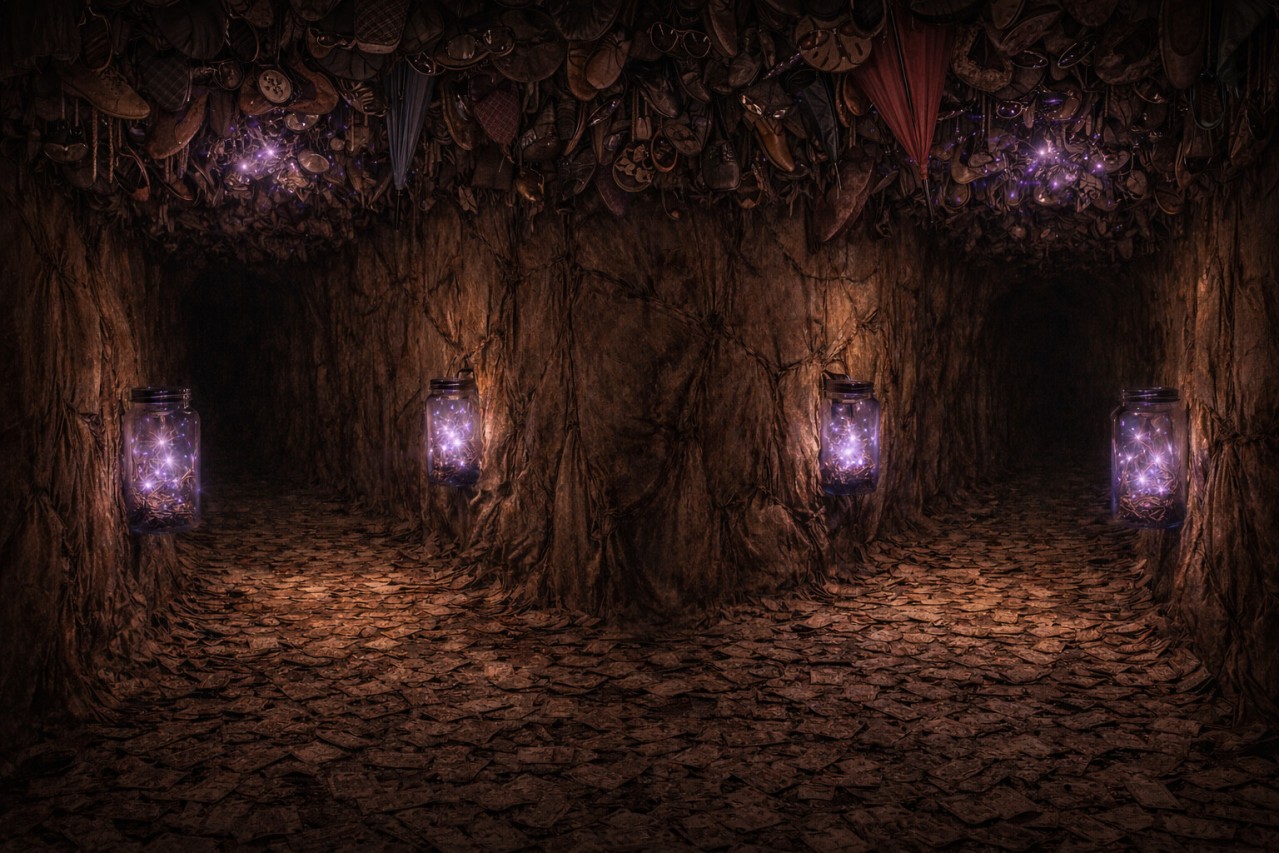
If the Rings are the performances, the Corridor is where the carnival digests you.
The Architecture: The Hall of Whispering Canvas
The walls are made of layered, sweat-stained canvas that feels uncomfortably like skin. The ceiling is low, forced down by the weight of thousands of "Lost and Found" items—umbrellas, spectacles, and single shoes—sewn into the fabric above.
The Lighting: There are no lamps. The path is lit by Jars of Bioluminescence. Inside these jars are the fireflies of the Fourth Ring—insects that glow with a sickly violet hue and feed on the sound of human heartbeats. The faster your heart races, the brighter they glow, lighting your way toward the next horror.
The Floor: The ground is soft and uneven. It isn't dirt; it’s a thick layer of discarded ticket stubs from the last century. Walking on them sounds like dry autumn leaves, but if you listen closely, the "crunch" sounds like muffled voices saying "Wait for me."
The Exhibits: The "Living" Static
Along the walls are alcoves containing Silas Thorne’s private collection. These are the "Static Acts" that weren't quite grand enough for the Rings.
The Taxidermy Witness: A stuffed crow that follows you with its eyes. It doesn't move its head; the eyes simply rotate in the sockets with a wet, clicking sound.
The Jar of Sighs: A large glass bell jar that appears empty. If you put your ear to it, you hear the collective "Ooh" and "Aah" of every audience that has ever died in the Fourth Ring.
The Melting Clock: A vintage pocket watch that doesn't track time, but rather the metabolic rate of the person looking at it. The hands spin faster as your life force drains away in the presence of the circus.
The Phenomenon: The "Thining"
The Corridor is where the physical world begins to lose its grip. This is where The Fourth Ring begins to leak through the seams.
Gravity Shifts: You might find yourself walking on the wall for a few steps without realizing it.
Temporal Distortion: You may feel you’ve been walking for five minutes, but when you reach the next ring, your watch says three hours have passed.
The Doppelgänger Effect: You might see yourself walking ten paces ahead of you, disappearing around a corner into the next tent. Whatever you do, do not catch up to yourself.
Elias Aethelgard’s Subways
Beneath the floor of the Corridor, Elias has constructed a network of brass pneumatic tubes. He uses these to transport "materials"—bones, scrap metal, and captured souls—between the rings.
If you press your ear to the canvas walls of the corridor, you can hear the thwump-thwump of the tubes. Occasionally, a brass pipe will burst through the canvas like a rib breaking through skin, venting hot, sulfurous steam into the hallway. This is Elias’s way of "breathing."
The Exit Ritual
To leave the Corridor and enter the next ring, you must pass through a Turnstile of Bone. It only turns if it senses a "payment." This doesn't mean money; it means a memory. Most people leave the corridor having forgotten the name of their first pet, the color of their mother’s eyes, or the reason they came to the circus in the first place.
The Corridor Rule: If you see a door marked "Staff Only," do not open it. That is not a room; it is a direct view into the internal gears of the Calliope. If you look at the gears, Elias might see you, and he is always looking for new "lubricant" for his machines.
Next: The Descent
Silas Thorne: The Rotting Emcee
Role: Ringmaster & Warden of the Fourth Ring
State of Being: Sentient Necrotic Thrall (The Circus will not let him die)
Quote: "Step forward, sinners! The flesh is temporary, but the show... oh, the show is eternal!" -
Leave your comment