
The "Reliquary"
The Fortune Teller

The Candle-Seer of the Fourth Ring
No handbill ever listed her name.
Between the knife-thrower’s wagon and the menagerie cages, there stood a tent too large for its pitch—canvas sagging as if weighed down by years rather than fabric. Its doorway breathed warm candlelight and the smell of old wax, dust, and copper. Those who asked about it were told only this:
“She was here before the circus had a name.”
The fortune teller called herself Madame Virelda, though records suggest that was not her birth name, nor even her second. When Aethelgard & Thorne first assembled their traveling exhibition, she arrived unannounced, walking alongside the wagons at dusk, never seen to sleep, never seen to eat. Elias Aethelgard tried to turn her away.
She looked at him once—and spoke his mother’s maiden name aloud.
Her tent was allowed to remain.
Inside, Virelda sat facing the doorway, never turning her back to those who entered. Age had not merely claimed her; it had layered upon her. Her skin was thin as parchment, creased with symbols that resembled neither wrinkles nor scars. Her eyes glowed faintly, reflecting candlelight even when none was present.
The crystal ball before her was not glass.
It was rumored to be mouth-blown from battlefield sand, fused with bone ash and grave-soil. The fog inside never cleared. Sometimes faces appeared—screaming, pleading, biting at the inside of the sphere as though it were a prison wall. The teeth were always broken. The eyes were always lifted upward.
Those who recognized the faces never returned.
Tarot cards lay scattered across her table, never in neat spreads. Cards shifted when no one touched them. Visitors swore the illustrations changed—The Hanged Man turning his gaze toward the door, The Tower already cracked before the lightning struck.
Madame Virelda did not tell fortunes.
She confirmed them.
She warned Elias Aethelgard of the accident that would end his life—and begin his work. She told Thorne exactly how many performances he had left before the audience stopped applauding and started screaming for mercy. She once whispered to the ringmaster that the circus had grown a fourth ring, one that could not be seen, only entered.
When pressed about the screaming head within her crystal ball, she answered calmly:
“That is not a spirit.
That is a promise.”
It is said the ball contains the first soul ever claimed by the circus—the first patron who begged for more than entertainment. Others say it shows whoever is closest to the truth at any given moment.
On nights when the lanterns flicker low and the canvas creaks like old skin, Madame Virelda raises her hands and stares toward the doorway, waiting.
She is not looking at who enters.
She is watching for who will never leave.
And when the circus finally folds—when the wagons rot and the posters fade—it is believed her tent will still stand, lit by candles that never burn down, offering answers no one is brave enough to ask.
Madame Virelda, Widow of the Quiet Dead
Madame Virelda was not born with the sight.
She married into it.
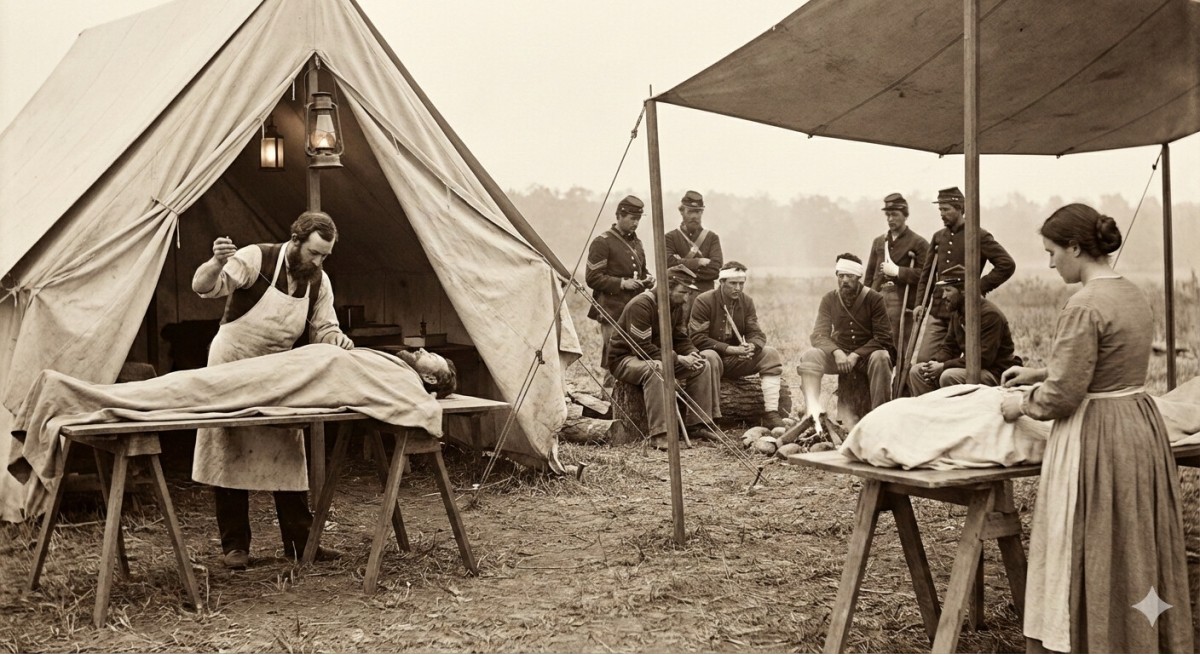
Her husband’s name was Mortimer Vireld, a licensed mortician who followed the Union and Confederate dead along the Mississippi River during the final years of the American Civil War. Mortimer did not work for towns. He worked for aftermath—setting up embalming tents beside field hospitals, rail depots, and temporary mass graves where the ground had not yet decided what it would accept.
Mortimer was respected, but never trusted.
Where other morticians drained and sealed, Mortimer listened. He believed the newly dead lingered—not as spirits, but as impressions, pressed into flesh like ink into paper. To preserve a body properly, he insisted, one must preserve its final awareness. His embalming mixtures were precise and unsettling: alcohol, arsenic, beeswax, river salts, and herbs drawn from pre-Christian burial rites. He kept ledgers of last thoughts the dying never spoke aloud.
Virelda—then known simply as Eliza Mae Vireld—assisted him.
She washed bodies by lanternlight. Reset shattered jaws so families could recognize their sons. Sewed mouths closed while Mortimer recorded measurements and murmurs no one else heard. She noticed the dead reacted differently to her touch. Some stiffened. Some leaked fluid from their eyes long after death.
Mortimer noticed too.
In the winter of 1864, Mortimer attempted what he called a perfect preservation—an embalming meant not to halt decay, but to hold awareness in place. The subject was a young deserter found frozen near the riverbank, his teeth broken from cold, his eyes locked upward in terror.
Eliza held the lantern while Mortimer worked.
The man did not remain silent.
The screams were not sound. They were pressure. The lantern burst. The mirrors cracked. When it ended, Mortimer collapsed, blood leaking from his ears and nose. He died before dawn, his face frozen in the same upward gaze as the deserter.
Eliza did not bury him.
She embalmed Mortimer herself.
That night, something shifted. The dead began to speak to her—not in words, but in images: futures already decaying, lives ending before they properly began. She understood then that death was not a door, but a corridor—and some souls never stopped walking it.
Years later, the crystal ball came into her possession, blown from Mississippi river-sand by a glassmaker who swore the furnace whispered while it burned. When Eliza placed the sphere near Mortimer’s preserved remains, fog bloomed inside it like breath on cold glass.
The first face appeared that night.
By the time Aethelgard & Thorne crossed her path, Eliza had shed her birth name and taken another. She recognized Elias Aethelgard immediately—not by sight, but by the familiar pressure in the air. The same pressure she had felt in the embalming tent decades earlier.
The circus did not corrupt her.
It completed her.
Now she sits within her candle-lit tent, a widow still keeping vigil. The crystal ball does not show the dead at random—it shows those closest to joining Mortimer in the long corridor.
And on certain nights, when the fog thickens and broken teeth clench inside the glass, two whispers can be heard overlapping:
One asking questions.
The other—Mortimer’s—still answering them.
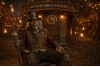
Silas Thorne: The Rotting Emcee
Role: Ringmaster & Warden of the Fourth Ring
State of Being: Sentient Necrotic Thrall (The Circus will not let him die)
Quote: "Step forward, sinners! The flesh is temporary, but the show... oh, the show is eternal!" -
Leave your comment